Popular Tags:

Small river reflections

December 30, 2012 at 1:39 pm

Notified that the first working party of 2013 is in doubt on my local syndicate trout stream, due to field to field flooding, I looked back on last season with the aid of our forum to while away a wet afternoon.

With a dozen of the thirty members reporting their exploits through the season on the forum, some with photographs, it was beneficial to reflect on what turned out to be a very good season for most. Our river is less than ten miles from spring to confluence, of which we have rights to the lower few miles, some of which we share with coarse fishing members of the club. In many places it spans fewer than ten feet from bank to bank, zig-zagging through copses and bordering fields, while supporting a good head of wild browns, many of the larger ones only showing up during the annual hawthorn and mayfly hatches, before sinking back to the safety of the many deep pools along the river’s course.

Each member has three days of fishing allocated each week, either start or end, with Wednesday a non fishing day. Even during the Mayfly hatch it is rare to meet more than a couple of other anglers. All fish are returned to the water, some are gluttons for punishment and give sport to many, while others learn to be more choosy. Seven foot rods and light lines are the order of the day, due in the main to overhanging trees and beckoning barbed wire fences. Waders are a must to be able to reach some of the more impenetrable  pools and even then a successful cast can often be more luck than judgement. Sometimes a feeding trout can only be watched, a cast being impossible. To me, I feel privileged just to be in the trout’s presence, the sun dappling the river as it rushes over the stones at the tail of  a pool, only a few miles from the surrounding towns.

My own season was almost charmed, usually fishing only a few hours each week, I was able to tempt a quality fish on each visit, smaller browns, chub and dace adding to the mix. My best wild fish was spotted feeding hard under the far bank foliage on a September afternoon, a slight dimple of the surface giving it away. A small yellow humpy was flicked in under the bank and taken straight away, resulting in a frantic fight that took me all over the river. This was a fat healthy brown trout of over a pound.


With a few exclusive,  expensive fisheries upstream, some introduced fish drop down into our water. In the last few days of the season, this beautiful eighteen inch brown was chasing minnows, when he took my hares ear nymph.

The week before, the weir pool at the head of  our water offered up a  fin perfect rainbow, again on a hares ear, this being the second in a week from the pool, photographs showing different spot patterns on the gill covers. The take had been a typical rainbow smash and grab, followed by a run round the pool that tested my little five weight, seven foot rod to the limit.

Writing these few words brings back many memories of spring and summer and the consolation that the twelve weeks to the start of a new trout fishing season will soon pass.


Cider bottled

December 24, 2012 at 2:56 pm

Being a cider making household, we share our kitchen during the autumn months with the latest batch, as it goes through it’s fermentation processes housed in a variety of demi-johns hidden under the table, unseen by our visitors sipping mugs of tea above.

Due to a cold wet spring and a similar summer, many apple trees did not set fruit and on those that did, the apples were slow to ripen and the cider making season was put back a month. This was the reason why we still had fermenting cider and I had instructions to bottle it before Christmas. The clear juice is syphoned out of the demi-johns, leaving the lees behind, this is called racking and being the second racking of this juice, the lees were minimal. I had to sample each dem-john and can report a very drinkable cider of good strength, has been produced this year, although the final fermentation takes place in the bottle and should be left for at least six months to mature.

In the past, having made beer and wine and even apple wine, when we had a surplus of fruit from our trees in the garden, it was only a matter of time, being a lover of cider, that I would make my own. We were fortunate to live close to an overgrown lane, that used to serve a big country house and also the Victorian village school, but now lay bypassed by modern roads, being encroached by brambles and various varieties of crab apple trees. Some were sweet others dry, an ideal mix for cider making. We no longer live in that area, but have found other trees to forage, although this year wild pickings were sparse, but once the word got out that we needed apples, the invites came to pick all we wanted from other’s gardens. About 20lb of apples are needed for a gallon of juice.

Continuing the theme of free apples, none of my “equipment” has been bought for purpose. The most important item is the cider press, which was made from odd lengths of 4 x 2 inch wood, forming two verticals and two horizontal struts, glued and screwed in place to create a stressed box. This I lock in an old workmate portable bench vice. The horizontals were cut to accommodate a baking tray into which two pieces of a 6 x 1 inch thick shelf were cut to form the crushing plattens for squeezing out the juice. A bottle jack from the garage supplies the crushing force, pushing up to the top horizontal, while pushing down onto the apple mash, held in an old net curtain, the juice flowing out into the baking tray. It would be easy to put a drain into the baking tray to flow down into a bucket, but it is no effort to empty it by hand, when it fills. The one labour saving device is an electric garden shredder, into which the washed, halved, or quartered apples are dropped, having cut out any bruising, but leaving the skin on. The rear end is raised on a brick so that the mash produced flows out of the spout into a bowl. The net is placed over an empty ice cream carton, before the apple mash is loaded into it and a sealed parcel formed. When the parcel is lifted out and placed between the plattens, juice will already have come out into the carton, which can be poured directly into the bucket through a flour sieve. I already had a five gallon bucket, which is the final destination of the juice ready for the introduction of a dried cider, or champagne yeast. On my first ever batch of cider, I covered the juice with a cloth and let it get on with natural fermentation from the wild yeast in the skins and the air, which took a couple of days, but now using a dried yeast sachet  for up to five gallons, sprinkled over and stirred occasionally over a couple of hours, the mix can be ready to transfer to the demi-johns for the first rapid ferment.

This is my backyard set up for cider making, it looks chaotic, but a production circle has been created, from washing, to chopping, pulping and juicing at the press. The flat apple cake byproduct is good food for chickens, or pigs, while on a compost heap it will soon become a nursery for young worms and speed up the composting process.

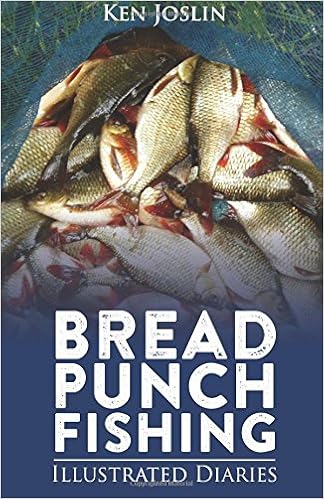
Bread punch on the Basingstoke Canal

December 19, 2012 at 1:47 pm

A change of plans meant a free afternoon this week. Hard frosts followed by a few day’s rain had left the fields and ditches waterlogged and my little river was bombing through, so my best option for a few hours fresh air was the twenty minute drive to the Basingstoke Canal.

With liquidized bread and some sliced white back in the freezer from my last outing on the river, bait was no problem and with tackle loaded, I was on my way before noon. Good news, a space in the car park, even with Christmas shopping in full swing; a longer walk, but better than the road side. I’d remembered to fix my trolley wheel puncture too,  which had been a bit of a let down, so a few hundred yards and I was at my swim, a sheltered spot in the town with gardens backing onto the towpath.

Temperatures were still below ten degrees C, but with no wind, or swans in sight, a decent afternoon’s fishing looked on the cards. Many “proper anglers” look down on the pole as a means of catching fish, but very light rigs and delicate baits can be presented by this method, while for the older angler such as myself, no longer possessing decent eyesight, or deft of touch, the rigs can be made up in the comfort of your home, or even bought ready made up at the tackle shop. After plumbing the depth to find the near and far shelf, I started off at the top of the near shelf without a touch, before increasing the depth a few inches and adding another metre to the pole.  This time a small ring radiating out from the float bristle indicated interest in the punch bait, another ring and it sank slowly beneath the surface. A lift and the float stayed down as a good roach pulled the elastic out from the pole tip. The elastic soon coped with the darting runs of the roach and the first of many was in the net.

I started to miss bites, or hook half ounce micro roach, so on went another metre and the float went out to the middle following another small ball of crumb. A three ounce roach, then the elastic stayed out with the steady throb of a six ounce skimmer bream. Good, this is what I came for, the swim has produced near two pound bream for me in the past. Regular feed was being rewarded by more roach, so I shallowed up and dropped the bait into the cloud, a fiddley bite developed into a slide away and the elastic followed into the water. I could see the flashes from a better skimmer and followed it with the pole as it dashed up and down the swim, until it was ready to be drawn away to my net. Another two skimmers followed and a good weight seemed on the cards, when disaster led a three pronged attack. First a hook in the lip of the last skimmer snagged my landing net and pulled through the lip, the line breaking before I could cut the net. Unable to find my spare made up hook links, another rig was attached  to the pole stomfo tip, was set to depth and cast in to sink as the float cocked. Excellent, more elastic out and an eight ounce roach eventually slid into the landing net. Disaster number two now struck. The hook was embedded in the thick part of the roach’s lip and would not come out, so I gave the disgorger a try, only to snap the fine wire hook shank. Two rigs in two casts. I had another rig, but this was not a match, although I was in the moment, catching a steady flow of better fish. As I sorted through my various made up packs of hooks, the third disaster struck, the swans arrived.

Mummy, Daddy and two signets now laid claim to my ground bait, their long necks reaching down to the bottom of the canal, black feet clawing the air to keep balanced. Game over. I found my hooks, looping on the new link and waited, until a mother and young daughter saved the day, when they arrived on the towpath and began feeding the ducks and squawking gulls, the swans making off at full speed in their direction. I decided to give it another half an hour, taking a few more ounce plus roach, but the better fish had moved off, leaving the three inch micro roach to feed at will. By three pm the light was going already, as the shortest day approached, and with a chill already in the air, I lifted out my keepnet to be greeted by that welcome sound of quality fish sploshing at the bottom. Transferred to my landing net and a quick weigh in, before returning, indicated five pounds of silver fish, not bad for two and a half hours fishing, considering the thirty odd micro roach not put in the net.

Busheyleaze Trout Fishery, Letchlade

December 15, 2012 at 5:38 pm

Following an invite to join two friends on a visit to Busheyleaze Trout Fishery at Letchlade  on Wednesday, it was too easy to make my excuses and say no. Probably the coldest day yet, with frost from the previous day still coating my car windscreen and covering the lawn, I shook my head in disbelief as I switch off my phone. They must be desperate.

The pair arrived at 10:30 am to find the lake half  frozen with frost coating the trees, joining a few other optimists at the water’s edge. Buying a half-day, three fish ticket each, they started out in front of the lodge, Pete using an Orange Blob and Ken with a Blue Flash Damsel, retrieved with a slow figure of eight. Very light takes and a few rainbows lost suggested a static offering was needed, so Ken set up with a Bloodworm under an indicator and soon had a five pound rainbow in the net. Pete followed suit and despite iced up rod rings, banked a four pounder. Ken was the first to reach his limit and posed for a picture to prove a point; you can still catch, even when the ground is frozen solid.

Pete’s limit followed shortly after, another four pound rainbow making a run for it beneath a sheet of ice, before being steered to the waiting net. I still think that they were crazy to go, knowing the conditions they faced, but hey, that’s fishermen.


Roach Therapy

December 12, 2012 at 3:51 pm

Fishing a five hour canal match in December is no compensation for the loss of flyfishing from your life for a few months, but having signed up for a canal match series in warmer times and gained enough points to put me in second place overall, I arrived at the Basingstoke canal with some optimism on Sunday.

After toiling to my peg with a puncture in one of my trolley tyres, I found myself next to my championship rival. A battle of the giants. We wished. My killer method is the bread punch, fished on a carbon pole over small balls of liquidized bread, one of the secrets being able to judge just how much to feed, too much and they won’t take the small punched pellet of bread bait, too little and the shoal will disperse. I always start off without feed and begin to feed the bread depending on the number of fish, usually roach, taken in the first few minutes. Lets just say that it was twenty five minutes before my bristle float, rotated and dipped a fraction of an inch and held. A lift of the pole and a two ounce roach broke my duck. Not good. My rival was still without a bite and others along the bank were studying their floats intently, so I put in another small ball and fished over it. Nothing. That little roach felt cold in my near frozen fingers, which if I hadn’t already guessed it, was a sign of a hard match to come. The carp family of fish, to which the roach belongs, go dormant below a certain temperature, time to try another method.

I changed my pole rig and put a worm tail on the hook, the float sinking out of sight before it got a chance to cock. A small perch. Good. Being a predator evolved from colder climes, perch will feed under six feet of ice, so on went another worm and another little perch was in the keep net. About this time my rival made a shout of approval, as he finally struck into his first fish. Bad news, his landing net was out to net a good roach. Probably more weight than my fish together. So we continued, until the final 90 minutes, when any sign of a bite dried up. The whistle blew at last to end the competition. We were out of the money, but I needed a lot more weight to have pulled ahead in the points. No chance, he had half an ounce more and was still ahead. Knowing I can’t fish one of the matches due to my MG Owners club’s New Year Lunch, my wife’s favourite event, that’s me out of the running for another year, unless I win all the other matches and he blanks.

After a hard match, when you begin to doubt your ability to catch fish, it’s good to go somewhere that you can bag up, so Monday afternoon saw me on the banks of a tiny river that runs through a park near my home, armed with the remains of my bread bait not used on Sunday’s match. Fed by two streams, one from the local water treatment works, the river is always warm and has a good head of roach. Just what I needed to get rid of my canal blues. I set up with a light stick float,  lobbed a ball of liquidized bread over towards the far bank and trotted down with the current. A couple of yards and the float bobbed before cruising off to the side, as a small chub intercepted the bread punch pellet. No need for the net, another cast, another small chub, this time eight ounces, put a good bend in my rod making a run for the tree roots opposite. The river here is only about two feet deep, but the fish are invisible, until you set the hook with a flash of silver. Another ball of feed and the roach began to line up for the bait, mixed with the odd rudd, or skimmer bream. A lady walking her dog stopped to watch, saying that she didn’t realize there were fish in the river and stayed to chat. With every fish, the lady’s little Jack Russell got excited, barking and pulling at it’s lead, until she bade her farewell. I was now able to concentrate on the job in hand, banishing Sunday’s match from my mind.  The fish  slowed down after a hectic two hours and I pulled my keep net out to reveal a decent haul of silver fish, the bright red fins of the roach and rudd standing out in the cold light. Wish I’d had this lot yesterday.

google.com, pub-4724135273945847, DIRECT, f08c47fec0942fa0